I will admit, this post has nothing to do with the internet at all. It does however relate greatly to a new and interesting form of advertising that I experienced first hand. Doubtless you have heard of Coke's famed energy drink, Red Bull. It has been advertised on television as granting the drinker the supernatural ability to fly (Though when I have tried it the only result was a nasty aftertaste and a slight buzz). Despite being disappointed with the beverage I cannot deny the effectiveness of the advertising, now whenever I think of energy drinks I think Red Bull. Recently this point was driven home with even greater force.
Noon last Saturday, it was a nice day warm with a cool breeze. I slept in, as I tend to do on weekends, and was enjoying the warm comfort of my bead when suddenly there came an unorthodox pounding at my door. Out side I heard a number of voices, some I recognized, others foreign, and as I stood I wondered when I became so popular that strange women would come to my room to greet me, not that I minded. I had brief fantasies of opening the door to a huge crowd of people, all of whom adored me and wanted to gift me with huge amounts of money. This was quickly followed by thoughts of being clubbed, bagged, and shipped to China as slave labor. Having covered most of the possible outcomes I figured I was prepared for what awaited me on the other side. I was sorely mistaken.
What greeted me where, easily, the two most cheerful people I have ever met. Both of them were female, between 5'6'' and 5'9'', and with them they bore the colossal smiles and strange cooler backpacks. Now let me say for a moment that I have worked at an amusement park, a place where unnatural friendliness is practically a requirement, yet I no one I had worked with there came even close to how friendly these people were. It was a attentiveness that could only have come 200mg of sodium, 27 grams of sugar, and 80mg of caffeine...per serving. Which is exactly what they were wearing on their backs.
Each of them bore with them a cooler pack, shaped like a can of Red Bull (slashed in half vertically, to be more form fitting). They informed me, in a stream of words so cheerful that it was almost sickening, that they had come to hand out free samples of Red Bull, and that she did not want me to miss out on the opportunity. Extending her hand, she offered me a beverage. drowsy and confused, I accepted. At once they swept from the house, almost as abruptly as they had come, pausing on the way out to inform me that they had placed some complementary cans about the apartment. And then they were gone.
For the rest of the week I have been discovering cans of Red Bull about the house, in the couch, the shower, kitchen cupboard, etc. which has kept me constantly thinking about the beverage, and the individuals who delivered it. I call them Red Bull people, although I think a simple equation would fit them better.
P + x(R) = Red Bull Person
(x being the number of R one can drink in about 15 minutes)
I have also been wondering about the ethics of this campaign. I cannot deny that it is effective, and I am pleased to know that they mostly stick to targeting friends, or friends of friends. Regardless I am left wondering if everone will take it with the same good humor as myself.
Sunday, September 30, 2007


Friday, September 21, 2007
Banner Ban
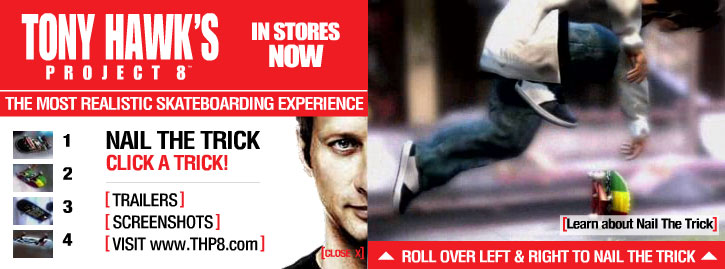
No, this is not a plug for the now out of date Tony Hawk's Underground (although I suppose I can not avoid the exposure). This, here, is a banner ad. Yet another friendly little gif that clutters the pages of the world. Some sources, like Darren Rose of Problogger (nothing against Darren, just the post) or AdBrite, would have you believe that Banner ads will provide and excellent form of branding, and great click through rates. This is basically completely untrue, at least for 99% of ads. I will not deny that there exist some good banner ads, the Tony Hawk one above is a great example. Unfortunately it is lost amongst a sea of really dreadful and invasive ads, things like "Click the Fart Button" and "Outrun the stick figure to win $1,000,000". Really truly bad ads that have scared us away from all banners, so much so that I actually avert my eyes when i see one.
But what really turns people off about banner ads is the danger, thats right, danger. Banner ads are legitimately risky to click. Why? Because in doing so you allow the linked site to send you anything they want. Here are a few links to give you some idea of what I mean. When the ad is clicked it forwards you to a site, and allows it to set upon you with all the cookies and spyware it could desire. If you doubt me, give it a try, I'm sure your computer will move 35% slower and be 100% less secure than before.
Now not all banners carry malicious Trojan viruses, but it only takes one infection to turn you away from all. I predict that if something is not done about this one click infection problem soon, banners as we know them will disappear from the internet all together. Not that it would be a bad thing.
Saturday, September 15, 2007
Peel Away

Just today, one day after posting about pop-ups I discovered something even more interesting. I was browsing the internet, looking for some one who would refute my prior post (conflicting opinions make great discussions) when I stumbled upon this little thing. I found it on a Google search for "Death of Pop-ups", linked off a post on the Marketing Essentials Blog. They are called Peel Away Ads, and claim to be the replacement for pop-ups.
On there main site the creators claim that peel away ads will excite your visitors, and are non intrusive and easy to use. The idea of the peel away ad is simple, when a visitor logs on they see on your page a small peel in one corner of the screen. With their interest peaked, the hope is that the visitor will mouse over the peel and see the ad. Then, inspired with the user friendliness and cool look of the ad, the visitor will click the link and view your product.

It is true that these ads will indeed be less intrusive than pop-ups, but will they be the end all of internet advertising that they would like you to believe? E-author Christopher Dolan, points out a few obvious flaws in this article. Peel away ads assume that your page has a good layout and open areas for their page curl. More importantly, you can only have one peel away on a page at a time (at least while still retaining a good look) where as you can have countless pop-up/under ads at any one time. So, in short, they may become more common, but a total replacement for pop-ups they are not.
Friday, September 14, 2007
!!!CONGRATULATIONS!1!
 I believe that the image to the right should speak for itself when it comes to this topic.
There are few forms of e-vertising more annoying, deceptive, and invasive than a pop-up. They come in all shapes and sizes, with plenty of bells ad whistles to attract you attention. Sometimes bright confetti fills the box with a big sign that says, congratulations you've won (blank). For others they try to trick you with fake windows warnings (note the fake 'x' close box). Or they could just bombard you with some load obnoxious computerized voice that drowns out your music with its monotone offers.

Regardless of the method all pop-ups work is the same way. They wait, generally on a delayed timer until you have been on the site for several seconds, then when you are just about to make your decision of what you want to read or click with pop-up springs forth, like a leopard from the underbrush, and intervenes. The particularly invasive ones will appear over the list of links, or a large block of text, hoping you might click it accidentally. For greater detail on exactly how they are placed look here. This comany does an excellent job of explaining why and how their pop-ups will boost your business.
But the real question is not how, but why. Why in the world would companies use something that is so outrageously annoying. The simple answer, because it works. Studies have shown that despite what people might think pop-ups, and the close cousin pop-unders, are dirt cheap in comparison to most other, conventional, advertising and generate an enormous amount of traffic. With 13 times the daily clicks of most banner ads, I guess that means there must be someone out there who clicks on these things.

Sunday, September 9, 2007
How do they find us?
Probably one of the biggest problems for all advertisers, especially those not based in the internet, is targeting. Any marketer can claim, "this is our market, and here is how we will reach them", However there is a big difference between cooperate assumptions and real fact. Advertisers learned this over the years and by now have developed many methods to find, understand, and sell to their consumers.
So of the easy ways include studying sales. What is selling, at what rate, and where. This gives the company a great idea of their strong and weak points, both in product and in location. They study not only their own trends, but those of other, related companies. Iams studies pet magazines, just as Microsoft looks at tech blogs. Here they can see what their consumer wants, if the boom of old people has brought a boom in old dogs then you can bet you will see some "senior dog chow" hitting the market.
Industries find other methods as well, they look at and perform studies, travel patterns, and common behaviors. Focus groups, online surveys, even the US census, they strive to know everything about their consumers. Now, with the advent of the internet, companies are finding that they have unpresidented access to the lives and habits of others, and though not all their methods are entirely ethical (spyware, cookies, etc.) cooperate America is leaping into the web searching for their next big hit.
So of the easy ways include studying sales. What is selling, at what rate, and where. This gives the company a great idea of their strong and weak points, both in product and in location. They study not only their own trends, but those of other, related companies. Iams studies pet magazines, just as Microsoft looks at tech blogs. Here they can see what their consumer wants, if the boom of old people has brought a boom in old dogs then you can bet you will see some "senior dog chow" hitting the market.
Industries find other methods as well, they look at and perform studies, travel patterns, and common behaviors. Focus groups, online surveys, even the US census, they strive to know everything about their consumers. Now, with the advent of the internet, companies are finding that they have unpresidented access to the lives and habits of others, and though not all their methods are entirely ethical (spyware, cookies, etc.) cooperate America is leaping into the web searching for their next big hit.
Subscribe to:
Posts (Atom)